Get started
What is Tracehold?
Runtime security for AI agents that act in your cloud: Tracehold decides every call, a connector in your cloud runs it, and every call names who it was for.
Overview#
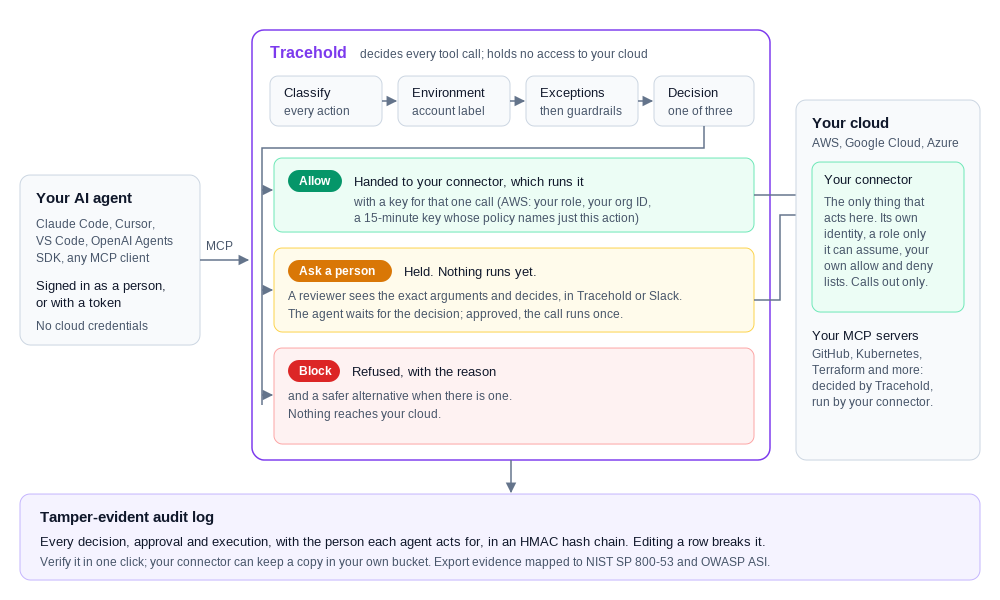
AI agents now change cloud infrastructure: a coding agent cleaning up a bucket, an ops agent restarting a service, a pipeline rotating a key. Tracehold sits between those agents and your cloud. Agents connect to it like any MCP server, and for every call it
- Checks who is calling: a coding agent signed in as the person using it, or a pipeline with its server's token, and that the tool is one the server allows
- Rates the risk: Read, Change, Destructive or Critical, with the reason (Risk levels)
- Notes where it runs: the environment you labelled its account with (Where a call runs)
- Decides with your exceptions, then the server's guardrails: allow (optionally with an alert), ask a person, or block
- Holds risky calls for a person, in Tracehold or Slack; approved, a call runs once, when the agent gets the answer or repeats it (Approvals)
- Hands each allowed call to your connector, a small process in your own cloud that runs it with a key for that one call. Tracehold's cloud holds no access to your cloud, and the agent holds no cloud credentials (Credentials and scope)
- Records every decision, approval and execution in a tamper-evident audit chain, which your connector can also copy to a bucket of your own
What it runs#
Tracehold's own tools run actions on AWS (any API operation), Google Cloud and Azure. Kubernetes, GitHub, Terraform, Cloudflare and Datadog actions are rated, decided and recorded, but Tracehold's tools do not run them; to run them, put the MCP servers you already use behind Tracehold, and your connector runs those too.
Agents need no SDK and no code changes: Claude Code, Cursor, VS Code, Windsurf, Claude Desktop, the OpenAI Agents SDK, LangChain, CrewAI and any other MCP client connect with an address (Connect your agents).
Aligned to#
- OWASP Top 10 for Agentic Applications 2026: ASI01 through ASI10. Nothing checks for ASI04 (supply chain): agents can call only the tools enabled on their server, but a tampered tool or dependency is not detected. For ASI07 (inter-agent communication) that means one identity per server; hand-offs between agents are not tracked.
- NIST SP 800-53 controls AC-6, AU-2, AU-12, IA-9, CM-5, SI-7, SC-28
Next steps#
From signing up to your first held, approved and recorded call.
How Tracehold worksWhat happens to one tool call, from the agent to your cloud and back.
The connectorThe only thing that acts in your cloud; Tracehold keeps the decisions and the audit trail.
Agent identityCoding agents sign in as the person using them, so every call says whose it was.